Repeater Stamps
The Standard Six *10% OFF*
The Standard Six *10% OFF*
Couldn't load pickup availability
10% OFF + FREE SHIPPING
6 halftone stamps carefully selected to give you a broad range of the different effects, textures and tones that Repeater Stamps offer. From here you will be able to determine which direction you'd like to go based on your experience OR the variety included in this bundle may be all you need for a very long time.
Includes : Four Halftone Dot Stamps and 2 Halftone Line Stamps
- 1mm Dot : 49 | 51
- .75mm Dot : 20 | 80
- .6mm Dot : 51 | 49
- .6mm Dot : 23 | 77
- .6mm Line : 56 | 44
- .4mm Line : 38 | 62
*Sample parchment paper is included for you to get a feel for masking and controlling where you want your dots and lines to go. It is the thinnest paper I've found and its waxy surface prevents ink from absorbing and mushing up your mask. It is very inexpensive, easy to find and the least frustrating to cut with your typical hobby knife. Other papers can be used with varying degrees of success. Even typical printer paper can be too thick (depending on the stamp) and can prevent the stamp from reaching its destination.*
Description :
This set offers the best range of dot size / density as well as a general ease of use. All Repeater Stamps take some practice to understand how much ink / paint should be applied for a smooth, consistent result. More spacious dot stamps require a softer press due to less dots holding the force of your press causing the dots to bend into an oval shape. That can be cool too though so don't hesitate to experiment! Condensed dot stamps are more susceptible to flooding which is when too much ink/paint collects between the dots. Wetting the stamp completely before use can help prevent ink from grouping and globbing together if the rubber is dry.
Just like any other art tool, these take practice to get the result you are looking for.
And for goodness sake : Don't sleep on the line stamp! Especially in contrast with the use of the dot halftones. Overlapping a line stamp for a cross hatching effect or for shadow and texture on city scapes, Gundam mechs or anything that could use some energetic tone. Overlapping the dot stamp can give you a huge array of surprising patterns as well.
Lining up the edge of a stamp printing directly beside another stamping in order to cover more area will ALWAYS be inconsistent unless you get tricky and find a way to hide the breaks / overlap. If the distance between two dots is .5mm you would have to land the next stamp within a very tiny percentage of that both horizontally and vertically. The reason being is what makes halftones so awesome and also very hard to make which is tessellation. If there is even the slightest consistent break in the pattern, it will stick out like a sore thumb because the human hand can't align the machine-accurate pattern.
Large stamps for large areas are coming 2026!
Stamp Specs:
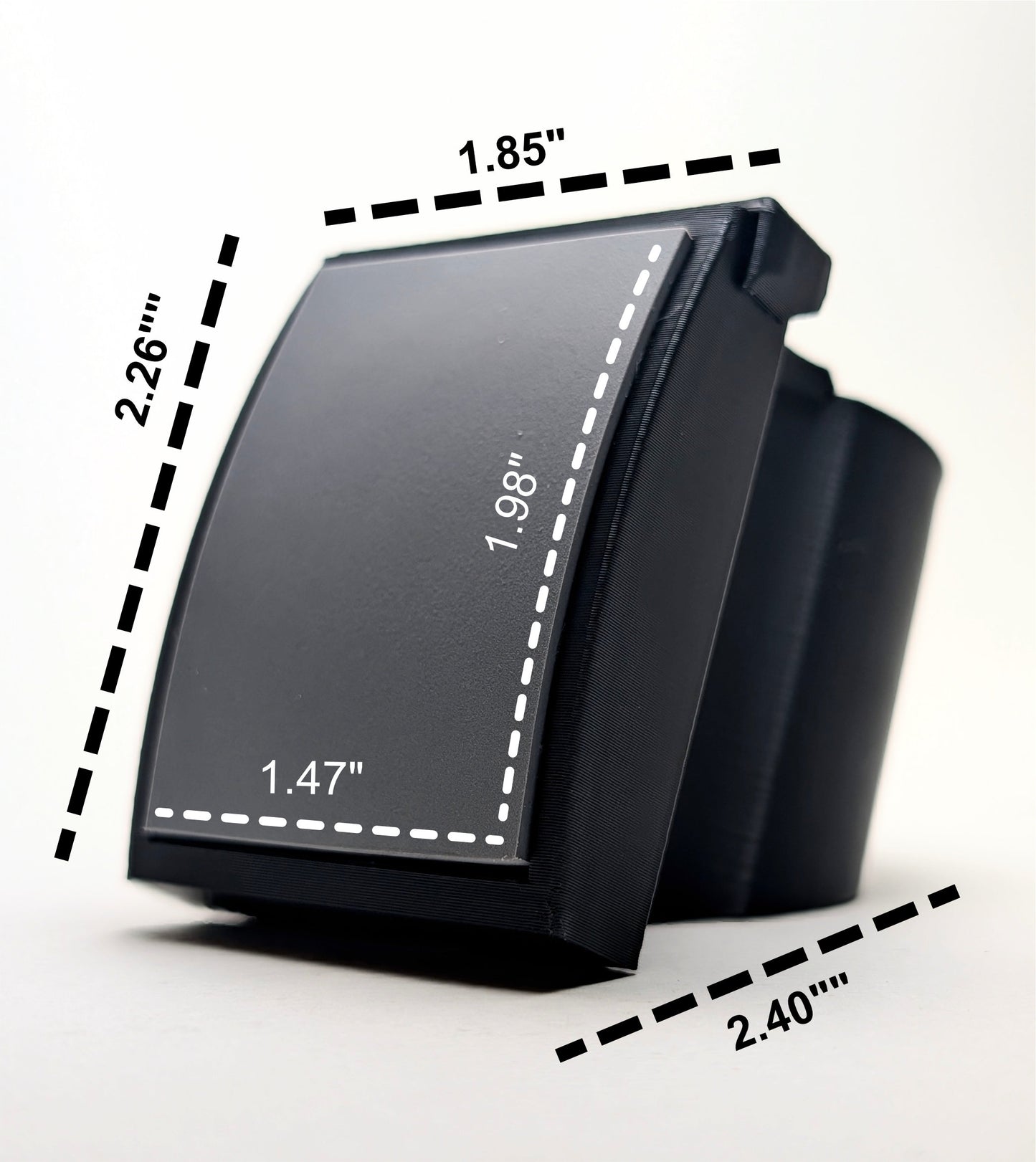
- Total active stamping area is 37mm x 50mm (~1.5"x 2")
- First percentage measures the total active area. The higher this number the more dots or lines there are which means it will be a tighter and more compressed pattern.
- The second percentage measures the inactive area. The higher this number the more space there is between the dots or lines.
Materials:
The stamp base is 3D printed using PLA+ bioplastic filament which is made from renewable, plant-based materials instead of petroleum with laser cut, synthetic stamp rubber. But don't let them fool you: they promote PLA plastic as biodegradable but it takes a VERY long time to degrade naturally and has to be processed at high temperatures so shouldn't go in your compost.
Industrial Composting: 3 to 6 months (requires temperatures over 55°C/130°F)
Soil/Home Composting: 1 to 3 years, if conditions are favorable, but often very slowly or not at all.
Landfills/Marine Environments: Decades, as conditions lack heat, moisture, and microbes, leading to microplastic pollution.
Share